

Nobody Has a Free Saturday to Audit Their Own AC
Let’s be honest about how this actually goes.
Your air conditioner is limping. You know it. But between work at the base, ball practice, and everything else stacked up this month, you’re not spending a weekend researching SEER ratings. So you wait. Then it quits on a 97-degree Tuesday and you make a five-figure decision in one sweaty afternoon with a stranger in your kitchen.
Sound familiar?
Here’s the thing. You don’t need a comprehensive audit. You need twenty minutes and four numbers — enough to walk into any quote with an anchor in your pocket, so you can tell whether the price in front of you is fair or fantasy.
Grab a phone flashlight and your last repair invoice. Let’s go.
Why You Feel So Behind on This Decision
First, a little grace for yourself. This decision is hard on purpose, and not because you’re bad at it.
Almost nobody in this industry publishes a replacement price. Go look. You’ll find “free estimates” and “upfront pricing” on a dozen Middle Georgia websites and not one actual dollar figure. So the first real number you ever see is the one written by the person who profits from it.
No anchor. That’s not a knowledge gap on your part — it’s a transparency gap in the trade, and it’s exactly why twenty minutes of your own homework changes the whole conversation.
Minutes 1 Through 5: Find the Age
Walk out to the outdoor unit. Look for the data plate, usually a metal sticker on the side near the electrical whip.
Most manufacturers hide the year in the first four digits of the serial, often as a week-and-year code like “1712” for the 17th week of 2012. Some spell the date out. Snap a photo either way, and write that year down. Everything else hangs on it.
In Houston County our cooling season runs long and wet, so equipment here logs far more hours than the same unit would in Ohio. Plan on twelve to fifteen years of useful life, not the twenty you’ll read on national websites. A well-maintained system beats that. A neglected one with a slow leak rarely reaches ten.
Minutes 6 Through 10: Count the Refrigerant Visits
Pull up your email or your invoice folder. Search for the word “refrigerant,” “Freon,” or “charge.”
How many times in the last three summers has somebody added refrigerant to your system?
This is the most powerful number in the audit. Refrigerant is not fuel. Your air conditioner doesn’t burn it or run low the way a car runs low on gas — it circulates in a sealed loop. If somebody added refrigerant, you have a leak. Full stop.
Two recharges in two seasons past year twelve is a replacement signal on its own. One recharge with a documented leak repair is just a repair. Zero recharges means your problem is somewhere else, and that’s good news.
There’s a cost angle too. If your system was installed between roughly 2010 and 2024, it almost certainly runs R-410A. Production ended in January 2025 and the remaining supply is phasing down, so every top-off costs more than the last one did.
You’re not buying a fix. You’re renting the system by the pound.
Minutes 11 Through 15: Walk the Rooms
Grab your phone and go room to room while the system is running. Hold your hand at each supply register.
You’re looking for one thing: does every room get real airflow, or does one end of the house get a whisper?
That back bedroom that never cools. The bonus room over the garage. The office that sits four degrees warm all summer. Most people assume that’s a tired air conditioner. Usually it isn’t.
It’s distribution. Leaking duct baking in a 130-degree attic, a crushed flex run, a return too small for the equipment. In pre-1980 homes around Macon and older Eastman neighborhoods, that’s the norm.
Why does it matter right now? Because if you replace the box and the ducts stay broken, you’ll spend north of eight thousand dollars and that bedroom will still be hot. It happens every summer around here.
One more check while you’re walking. If the thermostat reads 72 and the house still feels clammy, your system is likely oversized and short-cycling — cooling fast, shutting off early, never running long enough to pull humidity out. A bigger unit makes that worse. It’s a sizing and indoor air quality problem, fixable only if somebody measures instead of guessing.
Minutes 16 Through 20: Do the Only Math That Matters
Now take the repair quote you’re weighing, or the last one you got. Divide it by the number of good years the system realistically has left.
That’s your cost per year of comfort.
A $550 capacitor and fan motor job on a system with six years left costs about $92 a year. Say yes and stop agonizing. A $2,600 compressor on a system with three years left runs about $867 a year, and financing a correctly sized replacement over ten years will very likely beat it.
Notice what that math requires. It requires somebody to give you a remaining-life estimate — an actual number based on coil condition, compressor amp draw, and refrigerant history. Not a shrug at your system’s birthday.
If nobody gives you that number, you don’t have a diagnosis. You have a sales pitch. And you’re allowed to say that out loud.

Your Twenty-Minute Scorecard
Here’s how to read what you just collected. These are typical installed ranges in the Middle Georgia market, not a quote — your number depends on tonnage, ductwork, and equipment tier.
| What You Found | What It Usually Means | Typical Cost Range | The Question to Ask |
|---|---|---|---|
| Under 10 years, zero refrigerant adds | Repair, almost always | $150 to $650 for common part failures | “What failed, and why did it fail?” |
| 10 to 15 years, one leak found and repaired | Repair, and start planning | $400 to $1,200 | “What’s the remaining-life estimate?” |
| 12+ years, two or more refrigerant adds | Replace, and do it off-season | $7,000 to $12,500 for a standard right-sized system | “Was the leak found, or just topped off?” |
| Compressor failure past year 12 | Replace | $1,800 to $3,200 to repair vs. full replacement | “Is it the compressor or a part in front of it?” |
| One room never cools, rest of house fine | Neither — this is ductwork | $500 to $3,000 for sealing and repair | “Did you measure static pressure?” |
| Clammy at 72 degrees | Sizing or humidity, not capacity | Varies; often a control or airflow fix | “What’s the indoor humidity reading right now?” |
| Third repair in two summers | Replace, before next July | Plan it, don’t panic-buy it | “Show me both options in writing.” |
Look at the pattern. Almost every replace row needs more than one piece of evidence. One failed part is not a failed system. When a quote leans on a single symptom to justify replacing everything, that’s your cue to ask another question — not to sign.
What Changed in 2026 That Your Neighbor Doesn’t Know
Two things shifted, and both affect your number.
The federal 25C tax credit expired December 31, 2025. It was worth up to $2,000 on a qualifying heat pump. If your neighbor replaced in 2024, their number included help that no longer exists — and anyone still advertising that credit as current is quoting a dead rule.
Meanwhile, new equipment is built for R-454B and R-32 instead of R-410A. Redesigned systems, new supply chain, prices generally up.
Both push the same direction. With no subsidy softening the price, the money isn’t in shopping for the cheapest box anymore. It’s in getting sizing and distribution right the first time.
Where a Second Opinion Fits
Everything above gets you to a defensible position. It does not replace measurement, and it shouldn’t.
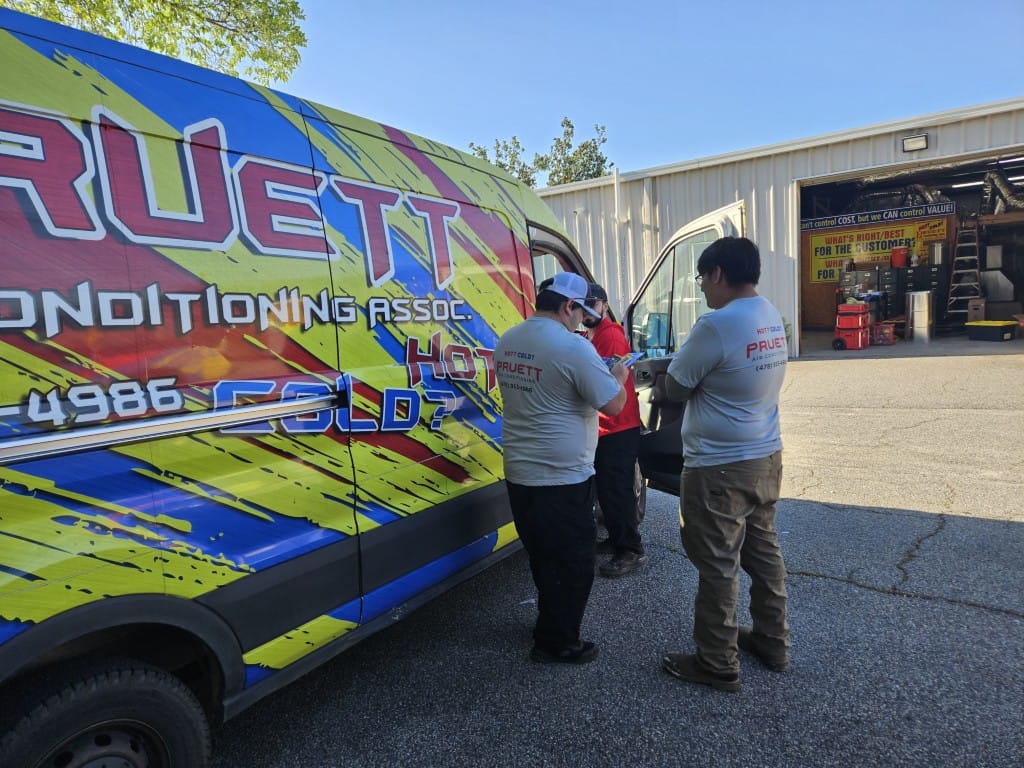
Pruett Air Conditioning has been in Middle Georgia since 1977, with offices in Warner Robins and Eastman, license CN209475, EPA and NATE certified technicians, and a Carrier Factory Authorized dealership. You probably know the company from decades of “Hot, Cold, Baby!” running on your television. That recognition cuts both ways: the owner gets stopped in the grocery store, so there’s nowhere to hide from a bad job.
If you already have a quote in hand, Pruett Air Conditioning offers a free second opinion on air conditioner repair recommendations, with the diagnostic fee waived when you move forward. Bring your audit. Ask for static pressure and indoor humidity readings before anyone talks tonnage.
The guarantees are worth reading before you decide anywhere — a ten-year No Lemon replacement, an apples-to-apples price match plus $100, and a $500 payment if a system can’t be fixed within 48 hours. Those terms work as price insurance on a five-figure decision, which is exactly what’s missing when nobody publishes a range.
For homeowners across Warner Robins and Bonaire, run this audit in April, not July. A planned system replacement means you compare calmly, review financing options including no-credit-check rent-to-own, and pick equipment on merit instead of on who can come today.
Frequently Asked Questions
Is the $5,000 rule still a reliable way to decide on an air conditioner?
It’s a starting point, not an answer. Multiply the repair cost by the system’s age and replace if it clears $5,000 — that ignores the two things that matter most in humid Georgia. Whether refrigerant is leaking, and whether your ducts are the real problem. A $500 repair on a 12-year-old unit scores $6,000 and says replace, but if that’s a capacitor on an otherwise healthy system, replacing is wasted money. Use the cost-per-remaining-year math instead.
How long should an air conditioner last in Middle Georgia?
Twelve to fifteen years is a realistic plan, a few years short of national averages, because our cooling season is long and humid and equipment simply runs more hours here. Systems on a regular maintenance plan with clean coils tend to reach the top of that range. Neglected ones with a slow refrigerant leak often don’t make it to ten.
Will a bigger air conditioner fix my hot back bedroom?
Almost never, and it usually makes things worse. Uneven cooling is a distribution problem — leaking duct, a crushed run, an undersized return — and oversized equipment short-cycles, shutting off before it pulls humidity out of the air. That’s how you end up with a cold, clammy house and a higher power bill. Have static pressure measured before anyone quotes you tonnage, and ask whether duct work is part of the diagnosis.
Does it matter that my system uses R-410A?
It matters for repair cost, not for safety. Your system runs fine. But R-410A production ended in January 2025 and the remaining supply is phasing down, so every recharge is more expensive than the last. If you’re adding refrigerant annually to a 12-year-old unit, that trend line is part of your decision. More on that in the FAQ section.
Twenty Minutes Buys You the Whole Conversation
You don’t need to understand refrigerant circuits to make a smart call about your air conditioner. You need the age, the refrigerant history, the room-by-room airflow, and the cost-per-remaining-year math.
Four numbers. Twenty minutes. Suddenly you’re not guessing — you’re checking.
Go find your last repair invoice and read it again with these questions in hand. The answer may have been sitting in that paperwork the whole time.
When you’re ready for real measurements behind it, Pruett Air Conditioning has been answering that call in Middle Georgia since 1977. Check the current specials, then request service and get an answer you can verify.