New to Warner Robins? Here’s Your AC Game Plan
The boxes aren’t even unpacked yet. You’re figuring out a new base, a new neighborhood, maybe new schools for the kids — and somewhere in the middle of all that, the air conditioning stops working.
Or worse: it works, but you have no idea if it’s going to hold up through a Georgia summer.
Military families near Robins AFB know this drill. PCS orders don’t come with a local contractor recommendation tucked inside. You show up, you figure it out fast, and you hope whoever you call actually shows up and tells you the truth.
This guide is for you. It covers what to check when you arrive, how to evaluate the AC system in your new home, what Middle Georgia’s climate will demand from it, and how to find a technician you can actually trust — even if you’re only here for a few years.
Georgia Heat Is Not the Same Everywhere
Look, if you’re coming from a northern installation, or even somewhere like the Pacific Northwest, the climate adjustment is real. Warner Robins sits in the heart of Middle Georgia, where summers are hot, humid, and relentless.
We’re talking weeks of 90°F+ temperatures, heat indexes regularly pushing past 105°F, and a stretch of summer that runs from late May through September. Your air conditioning system isn’t just a comfort item here. It’s essential.
A system that might coast through a mild summer somewhere else will get pushed hard in this climate. If the AC in your new home is older or poorly maintained, you’re going to find out quickly — and usually at the worst possible time.
First 30 Days: What to Actually Check
You don’t need to be an HVAC technician to do a basic evaluation when you move in. Here’s what to look for right away.
Check the Age of the System
Find the outdoor unit — the condenser — and look for the manufacturer’s data plate on the side. The manufacture date is either printed directly or encoded in the first few characters of the serial number. If you can’t read it, take a photo and search the brand name plus “serial number decode.” Most major brands have this information available.
In Middle Georgia’s demanding climate, a system older than 12 years is worth paying close attention to. It may still function, but it’s earned its place on your radar.
Turn It On and Actually Test It
Don’t just confirm the system runs. Set the thermostat to 70°F on a warm day and let it run for 30 minutes. Then check the temperature coming out of the supply vents.
If it’s blowing air that feels only slightly cool — not genuinely cold — there may be a refrigerant issue, a dirty evaporator coil, or an airflow restriction. The exception is a very mild day when the system has little load to overcome. Test on a warm afternoon for a real read.
Look at the Condition of the Outdoor Unit
Is the condenser coil visibly dirty or clogged with debris? Are the fins bent or damaged? Is there vegetation growing around it, blocking airflow?
These things matter. A coil that can’t breathe works harder, runs hotter, and fails sooner. It’s also an easy fix if you catch it early.
The Real Problem With Frequent Moves and HVAC
Here’s the thing that doesn’t get said enough: frequent relocation creates real gaps in home maintenance continuity. Every time you PCS, you inherit a system with an unknown history and no relationship with a local contractor who knows it.
The previous tenant or homeowner may have deferred maintenance. They may have had repairs done by whoever was cheapest at the time. You have no way to know.
That’s not a reason to panic. It’s a reason to get a baseline evaluation done quickly, before you’re in the middle of a heat emergency with a repair wait list stretching five days out.
What a Professional HVAC Evaluation Covers
A proper inspection by a NATE-certified technician goes well beyond “does it turn on.” Here’s a breakdown of what a thorough evaluation should include and why it matters:
| Inspection Item | What It Reveals | Why It Matters |
|---|---|---|
| Refrigerant level | Whether the system is properly charged | Low refrigerant = poor cooling, higher bills, compressor stress |
| Capacitor condition | Whether starting/running components are near failure | Capacitors fail suddenly; cheap to replace preventively |
| Coil condition (evaporator and condenser) | Efficiency and potential leak sites | Dirty or damaged coils tank efficiency and lifespan |
| Electrical connections | Loose or corroded wiring | Safety issue and performance degrader |
| Temperature differential across coil | Real-world cooling performance | Should be 14–20°F; less = problem |
| Duct condition and airflow | Whether conditioned air is actually reaching rooms | Leaky ducts can waste 20–30% of cooling capacity |
| Filter condition | Basic airflow check | A clogged filter stresses the entire system |
Getting this done in your first few weeks tells you exactly what you’re working with. No guessing. No finding out in August when parts are backordered and every HVAC company in the county is fully booked.
Finding a Contractor You Can Trust When You’re New in Town
This is the part that frustrates a lot of military families. You don’t have a network yet. You can’t ask a neighbor you’ve known for years. You’re searching online and hoping for the best.
Here’s what to look for. NATE certification matters — it means the technician has passed standardized testing specific to HVAC work, not just held a license. Carrier Factory Authorized Dealer status matters too — it’s not just a marketing badge, it requires ongoing training and certification that generic operators don’t meet.
And look for longevity. A company that’s been operating in the same community for decades has something to protect. They’re not going to disappear after one bad interaction. The reputation is built right there, in the same town where they live.
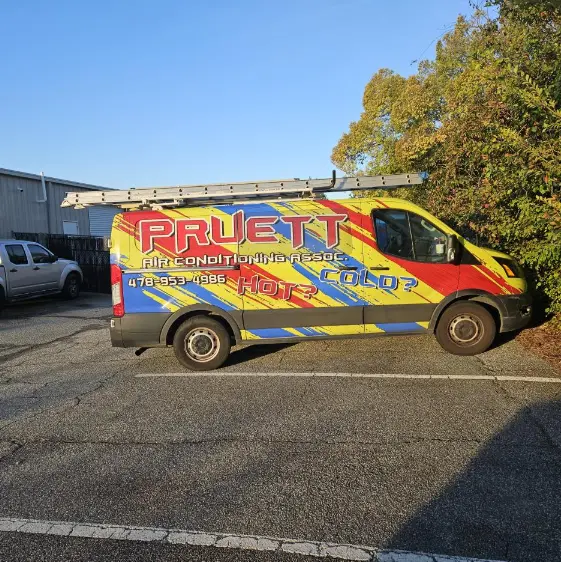
Pruett Air Conditioning has been serving Warner Robins and the surrounding Middle Georgia communities since 1977. Nearly 50 years. NATE certified. EPA certified. Carrier Factory Authorized Dealer. The technicians live here. The owners live here. When Robins AFB families are new to the area and need someone they can count on fast, Pruett is the name neighbors recommend.
What About When You’re Getting Ready to Leave?
This is worth thinking about too. If you know orders are coming and you’ve got a system that’s been running fine, a tune-up before you leave is still a good idea — both for you during your remaining time and for whoever comes after you.
But here’s what matters most: if a technician has told you the system is aging or marginal, it’s worth addressing before a PCS move, not leaving it for the next family to deal with in an emergency. That’s just the neighbor ethic, and it tends to come back around.
Frequently Asked Questions
How do I quickly assess an AC system when I move into a new home near Robins AFB?
Start with the age of the outdoor unit, then run a temperature test on a warm day — set to 70°F and check supply air temperature after 30 minutes. From there, schedule a professional evaluation within your first month. Pruett’s technicians serve the entire Warner Robins area and can typically turn around a full evaluation quickly. Getting a professional baseline removes all the guesswork from a system with an unknown history.
How long do AC systems typically last in Georgia’s climate?
In Middle Georgia’s heat and humidity, a well-maintained system realistically lasts 12–15 years. Units that have been maintained regularly tend to perform toward the higher end. Units that have been neglected — no tune-ups, filters left unchanged, coils never cleaned — can fail significantly earlier. If you’re moving into a home with a system that’s 10 or more years old, budget for the possibility of replacement within your tour.
Is it worth getting a maintenance agreement if I’m only stationed here for 2–3 years?
Yes, and here’s why. A maintenance agreement ensures your system gets a professional tune-up every spring, which keeps it running efficiently, extends its life, and catches small problems before they become emergency calls. For a military family that can’t afford a breakdown disruption, that predictability is worth a lot. Agreements typically include priority scheduling — which matters enormously when summer heat drives up demand for service.
What should I do if my AC fails and I’m waiting on orders?
Call a trusted local technician immediately and get an honest assessment of repair vs. replacement. If orders are close and the system is marginal, a repair might be the right short-term call. If you’re expecting to stay another year or two, the repair-vs.-replace math changes. Pruett can walk you through that conversation without pressure — just an honest read on where things stand.
Warner Robins Has Enough to Figure Out. Let the AC Be Easy.
You’ve got a lot on your plate. New duty station, new community, family getting settled — the last thing you need is to spend your first Georgia summer figuring out who to call when the AC goes out at 10 PM on a Wednesday.
Get the evaluation done early. Establish a relationship with a contractor before you need one urgently. And when you’re ready to do that, Pruett Air Conditioning is the team Middle Georgia has counted on for nearly 50 years.
Give them a call. Get it squared away. Then get back to settling in.